 播面
播面 什么是 Context API?它解决了什么问题?
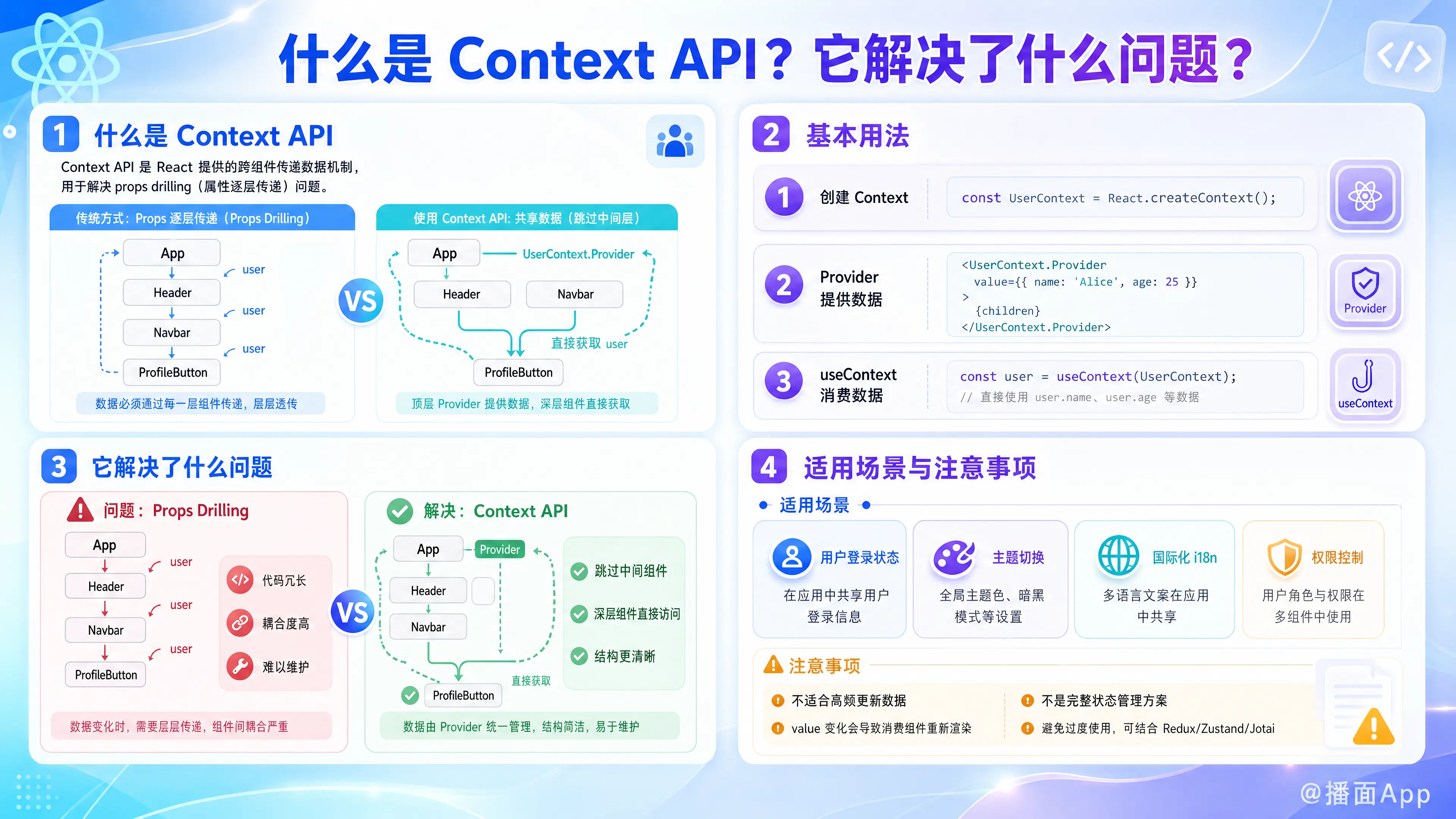
Context API 是 React 提供的一种跨组件传递数据的机制,用于解决在组件树中“props drilling(属性逐层传递)”的问题。
一、什么是 Context API?
在 React 应用中,如果某个数据(如用户信息、主题设置、语言偏好等)需要在多个层级较深的组件中共享,常规做法是通过 props 从顶层组件一层层往下传:
jsx
// Props Drilling 示例
<App>
  <Header user={user} />
    <Navbar user={user} />
      <ProfileButton user={user} />
这种方式会导致中间组件被迫接收并传递一些它们本身并不需要的 props,代码冗余且难以维护。
Context API 允许你在组件树中创建一个“上下文”,使得任意层级的子组件都可以直接访问该上下文中的数据,无需显式地通过 props 传递。
基本用法:
创建 Context:
jsxconst UserContext = React.createContext();提供数据(Provider):
jsx<UserContext.Provider value={{ name: 'Alice', age: 25 }}> <App /> </UserContext.Provider>消费数据(Consumer / useContext Hook):
- 使用
useContext(推荐):jsxfunction ProfileButton() { const user = useContext(UserContext); return <button>{user.name}</button>; } - 或使用
<UserContext.Consumer>(旧方式)。
- 使用
二、它解决了什么问题?
✅ 主要解决的问题:Props Drilling
- 问题:当数据需要传递给深层嵌套的组件时,必须逐层传递 props,即使中间组件不需要使用该数据。
- 后果:代码冗长、耦合度高、难以重构。
- 解决方案:Context API 让数据“跳过”中间组件,直接到达目标组件。
✅ 其他适用场景:
| 场景 | Context API的作用 |
|---|---|
| 全局状态管理(如用户登录状态) | UI可以根据登录状态动态变化 |
| 主题切换(深色/浅色模式) | App内所有组件可感知当前主题 |
| 国际化(i18n) | 语言包可在任意组件中直接使用 |
| 权限控制信息 | UI根据权限显示不同内容 |
⚠️ Context API 的注意事项与局限性
虽然 Context API 很方便,但也不是银弹:
不适合高频更新的数据:
- Context value变化时,所有消费该 context的组件都会重新渲染,即使只用了其中一部分。
- → 可能导致性能问题。建议结合
React.memo、拆分 context、或使用外部状态库(如 Redux)。
不是完整的状态管理方案:
- Context + useState/useReducer ≈ “轻量级 Redux”,但缺乏中间件、调试工具等高级功能。
- → For complex state logic, consider Redux/Zustand/Jotai.
避免过度使用:
- Not every prop should be put into context.
- Only use it for truly "global" or "cross-cutting" concerns.
✅ Summary
| Question | Answer |
|---|---|
| What is Context API? | A way to pass data through the component tree without manually passing props at every level. |
| What problem does it solve? | Eliminates props drilling and enables easier sharing of global data (theme, auth, locale, etc.). |
| How? | By creating a Provider that supplies data and Consumers (via useContext) that can access it anywhere in the subtree. |
💡 Think of it as an "injected dependency" for your component tree — useful for shared configuration or state that many components need to read (but not necessarily write).