Option 枚举和 Result 枚举的作用及常见用法?
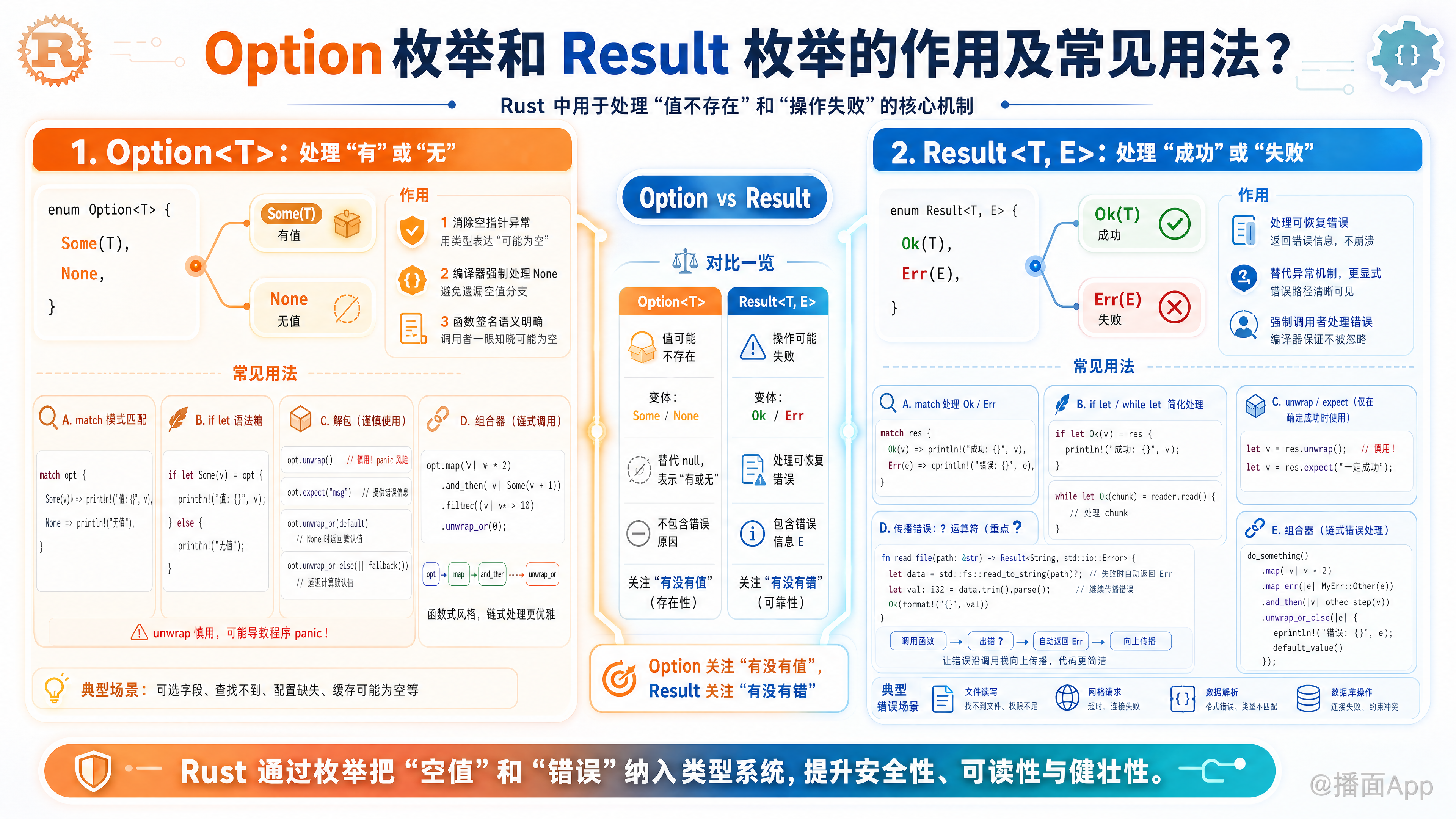
在 Rust 语言中,Option 和 Result 是两个最基础且最重要的枚举(Enum)。它们构成了 Rust 类型安全和错误处理的核心机制。
Rust 没有 null(空指针),也没有类似于 Java/Python 的 try-catch 异常机制。取而代之的是,Rust 使用这两个枚举来显式地处理“值不存在”和“操作失败”的情况。
1. Option <T>:处理“有”或“无”
Option 用于表示一个值可能存在,也可能不存在的情况。它替代了其他语言中的 null 或 nil。
定义
enum Option<T> {
    Some(T), // 包含一个值 T
    None,    // 没有值
}
作用
- 消除空指针异常:Rust 编译器强制你在使用
Option类型的值之前,必须先处理None的情况。你不能直接把Option<i32>当作i32来运算。 - 语义明确:函数签名返回
Option,调用者立刻知道“这个函数可能会返回空”,必须进行检查。
常见用法
1. 基本匹配 (Pattern Matching)
最安全的方式是使用 match 处理两种情况。
fn find_user(id: i32) -> Option<String> {
    if id == 1 { Some("Alice".to_string()) } else { None }
}

let user = find_user(1);
match user {
    Some(name) => println!("Found user: {}", name),
    None => println!("User not found"),
}
2. if let 语法糖
如果你只关心 Some 的情况,忽略 None。
if let Some(name) = find_user(1) {
    println!("Found: {}", name);
}
3. 解包 (Unwrapping)
unwrap(): 如果是Some返回值,如果是None直接 Panic(程序崩溃)。慎用,通常只在原型开发或确信不会为空时使用。expect("msg"): 同上,但可以自定义 Panic 的报错信息。unwrap_or(default): 如果是None,返回提供的默认值。unwrap_or_else(closure): 如果是None,执行闭包计算默认值(懒加载)。
let name = find_user(99).unwrap_or("Unknown".to_string()); // 返回 "Unknown"4. 函数式组合 (Combinators)
像链式调用一样处理数据,无需显式拆包。
map(): 如果是Some(x),对 x 进行操作并重新包装为Some;如果是None,保持None。and_then(): 类似于map,但闭包本身返回Option,用于链式依赖调用。
let len = find_user(1).map(|name| name.len()); // Option<usize>2. Result <T, E>:处理“成功”或“失败”
Result 用于处理可恢复的错误(Recoverable Errors),如文件 I/O、网络请求、解析错误等。
定义
enum Result<T, E> {
    Ok(T),  // 操作成功,包含值 T
    Err(E), // 操作失败,包含错误信息 E
}
作用
- 强制错误处理:Rust 编译器会警告你如果你忽略了
Result返回值。 - 类型化的错误:
E可以是任何类型(通常是实现了std::error::Error的枚举),让错误处理结构化。
常见用法
1. 基本匹配
use std::fs::File;

let f = File::open("hello.txt");

let file = match f {
    Ok(file) => file,
    Err(error) => panic!("Problem opening the file: {:?}", error),
};
2. 错误传播符 (? Operator)
这是 Rust 中最优雅的错误处理方式。如果结果是 Ok,取值;如果是 Err,直接从当前函数返回该错误。
use std::fs::File;
use std::io::{self, Read};

fn read_username_from_file() -> Result<String, io::Error> {
    // 如果 open 失败,直接返回 Err;成功则将 File 给 f
    let mut f = File::open("hello.txt")?;
    let mut s = String::new();
    // 如果 read_to_string 失败,直接返回 Err
    f.read_to_string(&mut s)?;
    Ok(s)
}
3. 处理特定情况
is_ok()/is_err(): 检查状态。ok(): 将Result<T, E>转换为Option<T>(丢弃错误信息,将Err变为None)。
4. 解包与默认值
与 Option 类似,Result 也有 unwrap(), expect(), unwrap_or() 等方法。
3. Option 与 Result 的转换
在实际开发中,经常需要在这两者之间转换。
Option -> Result:
ok_or(err)
将Some(v)转为Ok(v),将None转为Err(err)。plaintextlet opt = None; let res: Result<i32, &str> = opt.ok_or("Value is missing"); // res 变成 Err("Value is missing")Result -> Option:
ok()
将Ok(v)转为Some(v),将Err(e)转为None(丢弃错误细节)。plaintextlet res: Result<i32, &str> = Err("error"); let opt = res.ok(); // opt 变成 None
总结对比
| 特性 | Option <T> |
Result <T, E> |
|---|---|---|
| 含义 | 值可能缺失 (Nullable) | 操作可能失败 (Success/Failure) |
| 变体 | Some(T), None |
Ok(T), Err(E) |
| 应用场景 | 查找字典、可选参数、空指针替代 | 文件读写、网络请求、数据解析 |
| 常用组合子 | map, and_then, unwrap_or |
map, map_err, and_then |
| 核心语法糖 | if let, while let |
? (传播错误) |
一句话最佳实践:
如果“没有值”是正常状态的一种(比如没找到用户),用 Option;如果“没有值”意味着出错了(比如连不上数据库),用 Result。